How cricket betting odds work, and how to read a rate before you stake
A price on a cricket market answers two questions at once: how much comes back if you win, and how often you need to win for that to be worth it. Most beginners read only the first half.
Before the first ball
Three ways the same price is written
You will meet cricket odds in three formats. They say exactly the same thing.
Decimal — 1.90. The total that comes back per rupee staked, stake included. ₹100 × 1.90 = ₹190. Most sites showing rupee accounts use this.
Fractional — 9/10. Profit per unit staked. 9/10 means ₹9 profit for every ₹10. Convert to decimal by adding one: 9/10 + 1 = 1.90.
Rate — 90. In Indian betting talk, a rate is the profit per ₹100. A rate of 90 is ₹90 profit on ₹100, which is 1.90 in decimal. A rate of 40 is 1.40. The local rate language goes further during a match, with separate words for taking and giving a rate; those belong to in-play betting and are not covered here.
| decimal | fractional | rate (profit per ₹100) |
|---|---|---|
| 1.40 | 2/5 | 40 |
| 1.80 | 4/5 | 80 |
| 1.90 | 9/10 | 90 |
| 2.00 | 1/1 (evens) | 100 |
| 2.50 | 3/2 | 150 |
| 3.50 | 5/2 | 250 |
Before the first ball
Turn the price into a percentage
Divide 1 by the decimal price. The answer is the implied probability — how often the outcome must happen for the price to be fair.
- 1.40 → 1 ÷ 1.40 = 71.4%
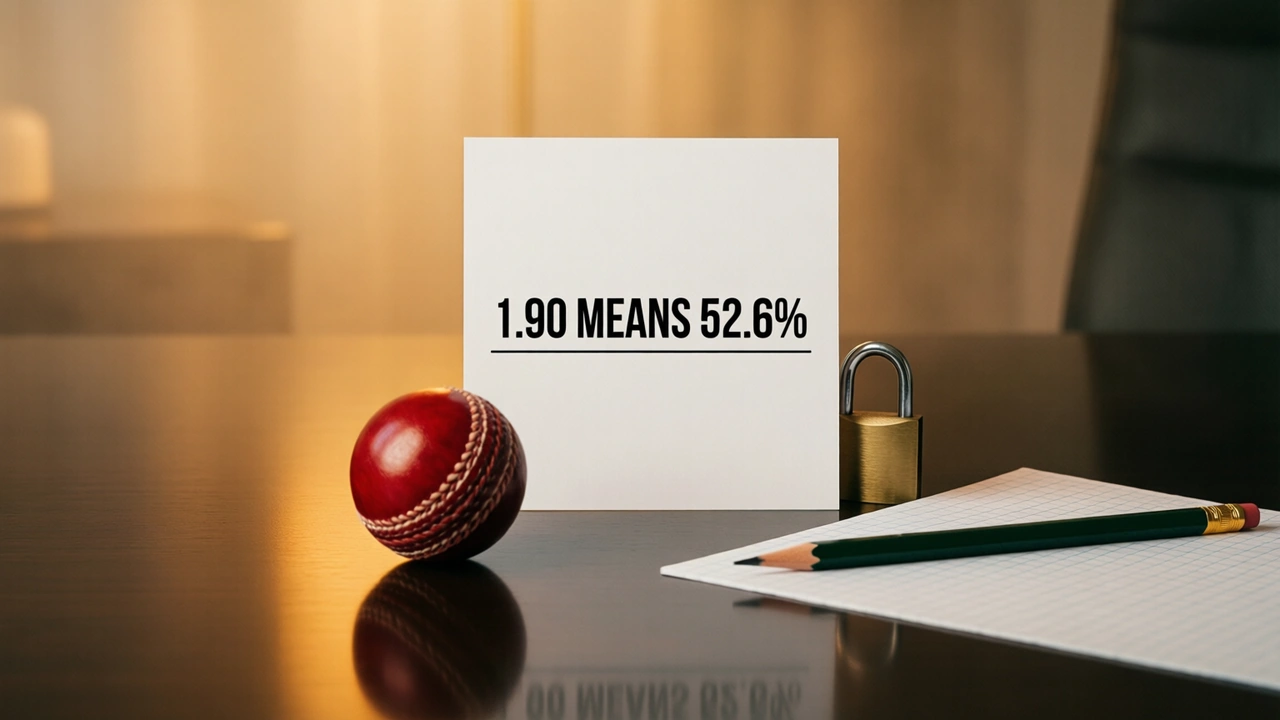
- 1.90 → 52.6%
- 2.50 → 40.0%
- 3.50 → 28.6%
Read it as a question to yourself. At 2.50, the site is saying this team wins about 40 times in 100. Do you believe it is more? If you cannot say yes with a reason, the price is not an opportunity. It is just a price.
Before the first ball
Find the margin in a market
Add the implied probabilities of every outcome in one market. A fair market would add up to exactly 100%. A bookmaker's market always adds up to more, and the excess is the margin.
A level match, both sides 1.90
52.63% + 52.63% = 105.26%. Margin: 5.26%.
A favourite and an outsider, 1.80 and 2.05
1 ÷ 1.80 = 55.56%. 1 ÷ 2.05 = 48.78%. Together 104.34%. Margin: 4.34%.
The second market looks less generous on the favourite and more generous on the outsider, yet its margin is smaller. You only see that by adding.
A Test match with three outcomes
A draw adds a third number to the sum. Three-way markets usually carry a larger margin than two-way ones, because there is one more outcome to price. The method does not change: add all three.
Before the first ball
Take the margin out
To see what the bookmaker thinks the real chances are, divide each implied probability by the total.
In the 1.80 / 2.05 market: 55.56 ÷ 104.34 = 53.2% for the favourite, 48.78 ÷ 104.34 = 46.8% for the outsider. Those two add up to 100%. They are the site's estimate with its cut removed.
If your own view of the match differs from those figures by more than a couple of points, you have a reason to bet. If it does not, you are paying the margin for the privilege of watching.
Before the first ball
Why prices move before a match
A pre-match price moves for three reasons: team news (a key player left out), the toss and pitch report, and weight of money on one side. Only the first two carry information about the cricket. The third tells you what other people did.
A price you have already accepted does not move with them. Once your slip is confirmed, the number on it is fixed. The step-by-step guide explains the moment that happens.
Before the first ball
Reading a price: the checklist
- I can say the return on ₹100 at this price.
- I have worked out 1 ÷ price as a percentage.
- I have added both (or all three) sides and know the margin.
- My own estimate of the outcome is higher than the site's margin-free figure.
- I know why the price moved, if it did.
FAQ
What does odds of 2.00 mean in cricket betting?
Your stake is doubled if you win: ₹100 returns ₹200. The implied chance is 50%.
What is a rate of 80 in cricket betting?
Profit of ₹80 on a ₹100 stake, which is 1.80 in decimal and an implied chance of 55.6%.
Are lower odds safer?
They are likelier to win and pay less when they do. Whether a price is good depends on how it compares with the real chance, not on how low it is.
How do I know the bookmaker's margin?
Add up 1 ÷ price for every outcome in one market. Anything over 100% is the margin.