Is cricket betting profitable? Start with the arithmetic
Every guide to winning at cricket betting starts with tips: follow the pitch report, watch team news, bet on what you know. None of that is wrong. It just comes second. First comes a number that decides whether any of it can work.
Before the first ball
The number you have to beat
Every price carries a strike rate — the share of bets at that price you must win to break even. It is 1 divided by the price.
| price | break-even strike rate | wins needed out of 100 bets |
|---|---|---|
| 1.50 | 66.7% | 67 |
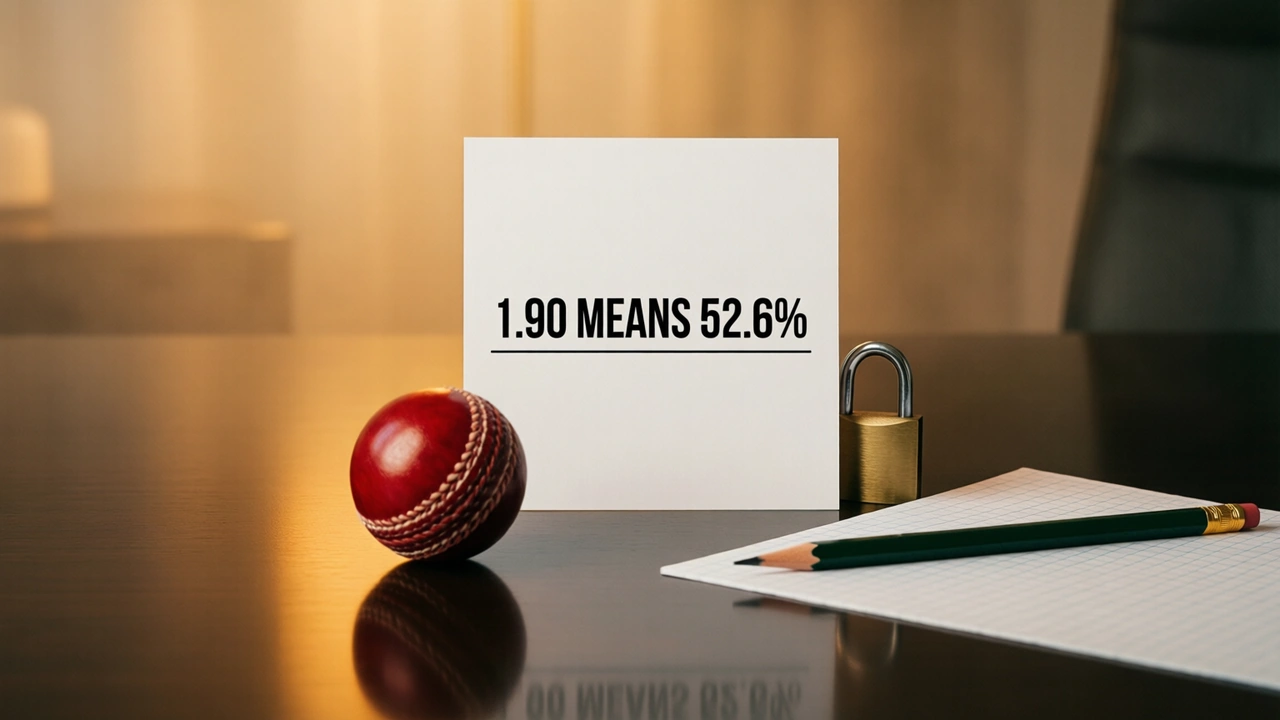
| 1.90 | 52.6% | 53 |
| 2.00 | 50.0% | 50 |
| 3.00 | 33.3% | 34 |
"Winning" at cricket betting means one thing: being right more often than that column, over enough bets for luck to wash out. Anything else is a good week.
Before the first ball
What the margin costs over a season
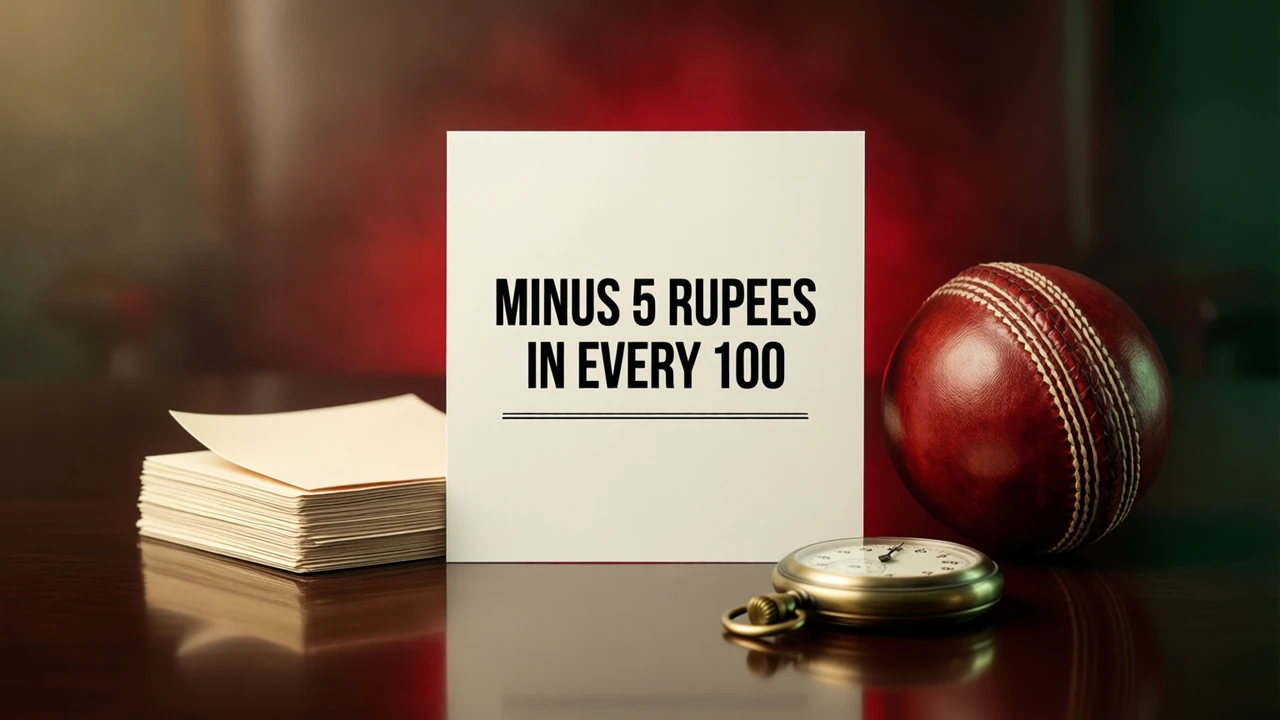
The bookmaker's margin works against you on every bet, whether you win it or not. At a typical 5% on a two-way market, a bettor with no edge at all loses about ₹5 of every ₹100 staked, on average.
Scale that to a season. Someone who stakes ₹500 on each of 60 IPL matches has put ₹30,000 through the book. With no edge, the expected result is a loss of around ₹1,500 — and the actual result will swing well above or below that from luck alone.
To turn that into a profit, the same person needs to be right noticeably more often than 52.6% at 1.90. Across 60 bets, that means roughly 33 or more winners, every season, consistently.
Before the first ball
Earning money versus winning a bet
"How to earn money from cricket betting" is one of the most searched questions on the subject. It frames betting as income, which is where the trouble starts.
Income is predictable. Betting results are not, even for someone with a genuine edge — a run of ten losses at 1.90 turns up eventually for anyone who bets long enough. A person who needs the money from the next bet will stake it at the worst moment, raise stakes after losses, and treat the margin as a hurdle they can outwork.
A more honest framing: betting costs money on average, and a small minority find an edge large enough to offset that cost. If you cannot say what your edge is in one sentence, you are paying for entertainment. That can be a fair trade. It is not a job.
Before the first ball
What an edge actually looks like
An edge is not a feeling that a team will win. It is a difference between your estimate of a chance and the book's margin-free estimate, big enough to clear the margin.
A worked example. The market prices a match 1.80 / 2.05. With the margin removed, the book rates the outsider at 46.8% (the odds page shows the calculation). You have reason to believe — a pitch that suits their attack, the favourite's best bowler rested — that the outsider's true chance is closer to 52%.
At 2.05, the expected return on ₹100 is 0.52 × 205 = ₹106.60. That is an edge of about 6.6%. If your 52% is right, over many such bets you come out ahead. If it is wrong, you do not.
Everything depends on the estimate being better than the book's, repeatedly. Most people's are not, and there is no shame in that — the book employs people who do nothing else.
Before the first ball
Things that do not change the arithmetic
- Switching markets. Handicap and odd/even carry margins too. A new question is not a new edge.
- Doubling after a loss. It raises the stake, not the chance. The margin grows with it.
- Tips from a channel. A tip is somebody else's estimate. It helps only if theirs beats the book's, and a public tip is already in the price by the time you read it.
- Bonuses. A welcome pack adds balance and a turnover requirement. The margin applies to every rupee of that turnover.
Before the first ball
Before you call it winning
- I know the break-even strike rate at the prices I bet.
- I keep a record of every bet, including the price and the stake.
- After 50 bets I compare my strike rate with the break-even figure.
- My stakes do not rise after a loss.
- Money I need for anything else is never on the balance.
FAQ
Is cricket betting profitable?
For most people, no: the margin means the average result is a loss. A small minority with a genuine, repeatable edge come out ahead over time.
What strike rate do I need at 1.90?
52.6%. Below that, you lose money over time even if you win most weeks.
Can a strategy guarantee wins in cricket betting?
No. A strategy can only improve your estimate of chances. Nothing removes the margin or the variance.
How much does the bookmaker's margin cost me?
About ₹5 of every ₹100 staked on a typical two-way market, on average, if you have no edge.